外挂式插件编程思路【敏捷框架篇】(9)
有了外挂式思维基础,开始涉及框架。个人理解,所谓框架就是自己研究一些习惯、一些风格,出于某个目的(如快速开发),而设计并开发出的一套生产工具。
我这里对框架的需求主要是两点
1、快。为了减少开发的工作时间。
2、简。是简化开发过程、简化开发思想,与大部分人理解的代码简洁是两回事。以前一个前辈跟我说过一句话,代码写得好不代表真的好,代码写得结构简单别人看得到才好。很多时候写4行代码比写1行代码好,因为有的时候方便阅读更重要。
框架起步,先定义一下自己的标签,我这里就用 zs(杂烧)
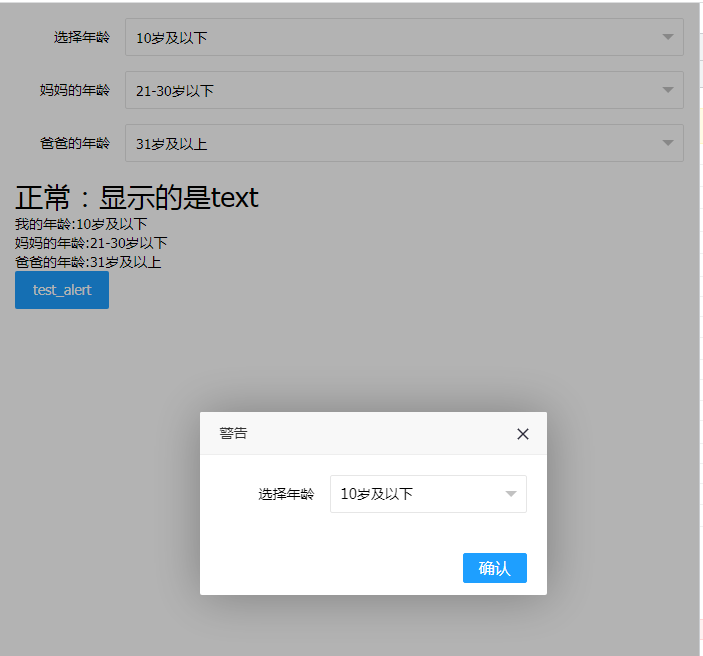
如:<zs zs-type="select" zs-option="option" zs-model="form.age" zs-change="age_change" zs-title="选择年龄" zs-placeholder="请选择"></zs>
下面代码,讲解思路,有点乱,非最终代码
【index.html】
<!DOCTYPE html>
<html ng-app="myApp"  ng-controller="myhtml">
	<head>
		<meta charset="utf-8" />
		<title>外挂式插件编程思路(敏捷框架篇)</title>
		<script src="jquery.min.js"></script>
		<script src="angular.min.js"></script>
		<script src="app.js"></script>
		<link rel="stylesheet" href="css/layui.css" media="all">
	</head>
	<body>

		<form class="layui-form">
			<!-- 框架需要有自定义的语法 -->
			<zs zs-type="select" zs-option="option" zs-model="form.age" zs-change="age_change" zs-title="选择年龄" zs-placeholder="请选择"></zs>

		</form>

		<select ng-model="form.age">
			<option value="" >请选择</option>
			<option ng-repeat="x in option" value="{{x.value}}" ng-selected="form.age==x.value">{{x.text}}</option>
		</select>


		<script>

			function load_select()
			{
				//所有select的渲染对象
				app.$scope.render_select={
					data:{},
					open:function(id)
					{
						console.log('open');
						if(!app.$scope.render_select.data[id].open)
						{
							app.$scope.render_select.data[id].open=true;
						}else{
							app.$scope.render_select.data[id].open=false;
						}
					},
					select:function(id,obj)
					{
						console.log('select',id);
						console.log(obj);
						let this_model=app.$scope.render_select.data[id].model;
						let this_change=app.$scope.render_select.data[id].change;

						if(this_change)
						{
							let eval_change=`
							if(obj.value != app.$scope.${this_model})
							{
								if(app.$scope.${this_change}) app.$scope.${this_change}(obj.value);
							}
							`;
							console.log(eval_change);
							eval(eval_change);

						}


						let eval_model=`app.$scope.${this_model}=obj.value;`;
						eval(eval_model);
						console.log(eval_model);
						app.$scope.render_select.data[id].open=false;


					},
					show_text(option,value)
					{
						var text='';
						for(var i in option)
						{
							if(option[i].value==value)
							{
								text=option[i].text;
								break;
							}
						}
						return text;
					}


				};
				$('zs[zs-type="select"]').each(function(){
					var $this=$(this);
					var this_model=$this.attr("zs-model");
					var this_option=$this.attr("zs-option");
					var this_change=$this.attr("zs-change");
					var this_title=$this.attr("zs-title");
					var this_placeholder=$this.attr("zs-placeholder");
					var this_id=(new Date()).valueOf()+'_'+Math.random();
					//当前select的渲染对象
					app.$scope.render_select.data[this_id]={
						open:false,
						model:this_model,
						change:this_change
					};


					var this_select_html=`
						<div class="layui-form-item" id="${this_id}">
							<label class="layui-form-label">${this_title}</label>
							<div class="layui-input-block">
							  <div class="layui-unselect layui-form-select {{render_select.data['${this_id}'].open==true ? 'layui-form-selected' : ''}}">
								<div class="layui-select-title" ng-click="render_select.open('${this_id}')">
									<input type="text" placeholder="${this_placeholder}" ng-attr-value="{{render_select.show_text(${this_option},${this_model})}}" readonly="" class="layui-input layui-unselect">
									<i class="layui-edge"></i>
								</div>
								<dl class="layui-anim layui-anim-upbit" style="">
									<dd lay-value="" class="layui-select-tips">${this_placeholder}</dd>
									<dd lay-value="{{select_option.text.value}}" class="{{${this_model}==select_option.value ? 'layui-this' : ''}}" ng-repeat="select_option in ${this_option}" ng-click="render_select.select('${this_id}',select_option)">{{select_option.text}}</dd>

								</dl>
							  </div>
							</div>
						</div>
					`;
					$this.before(app.html(this_select_html));
					$this.remove();


				});
				app.update();
			}


			//框架的 标签功能 解析demo
			//<zs zs-type="select" zs-option="option" zs-model="form.age" zs-change="age_change" zs-title="请选择您的年龄" zs-placeholder="请选择"></zs>

			var app=ng_app();
			app.init(function()
			{
				//tab标签相关
				app.$scope.form={
					age:''
				};
				app.$scope.option=[
					{value:'1',text:'10岁及以下'},
					{value:'2',text:'11-15岁'},
					{value:'3',text:'1-20岁'},
					{value:'4',text:'21-30岁以下'},
					{value:'5',text:'31岁及以上'},

				];
				app.$scope.age_change=function(option)
				{
					console.error('选择了年龄');
					console.log(option);
				}

				load_select();
				app.update();//页面渲染
			});
		</script>

	</body>
</html>
【app.js】
function ng_app()
{
	var MyApp=
	{
		app:null,
		init:function(back)
		{
			console.log('init');
			var me=this;
			var app = angular.module('myApp',[]);
			app.controller("myhtml",function($scope, $http,$window,$compile)
			{

				me.$scope=$scope;
				me.$http=$http;
				me.$window=$window;
				me.$compile=$compile;


				back();
			});

			this.app=app;
		}

		//更新模板渲染 优化ng频繁更新有报错,这里加1毫秒延迟 避免报错
		,update:function(){
			var me=this;
			setTimeout(function(){
				try{
					me.$scope.$apply();
				}catch(e){}
			},1);
		},
		//配合jq使用,jq后的模板,重新渲染
		html:function(html)
		{
			var that=this;
			try{
				var result=that.$compile(html)(that.$scope);
				if(result.selector)//假设存在 this_tpl_new.selector 则认为ng变量不存在失败了
				{
					//console.error(this_tpl_new.selector);
					var result=html;
				}
			}catch(e){
				var result=html;
			}
			return result;

		},
		new:function(){
			return this;
		}

	}
	var result=MyApp.new();
	return result;
};
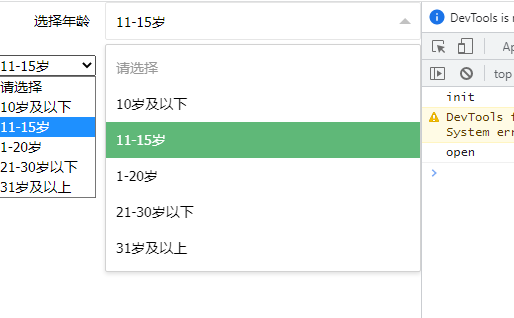
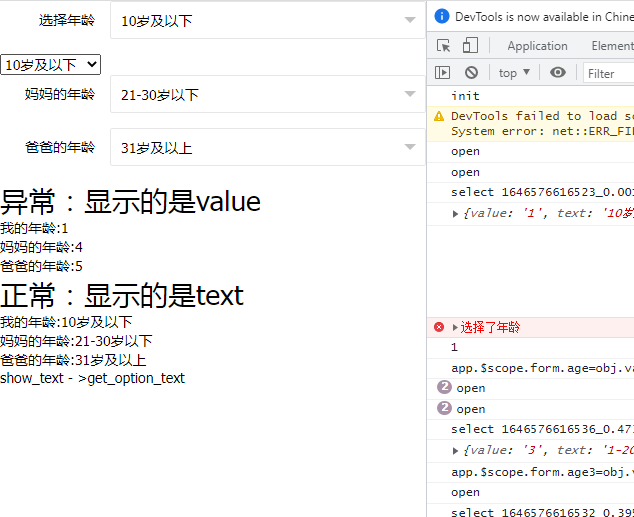
css用的layui,这里也是模仿layui的select,与原生的select双向绑定,非常完美。